Saturday, 13 May 2023

The electron–proton bottleneck of photosynthetic oxygen evolution

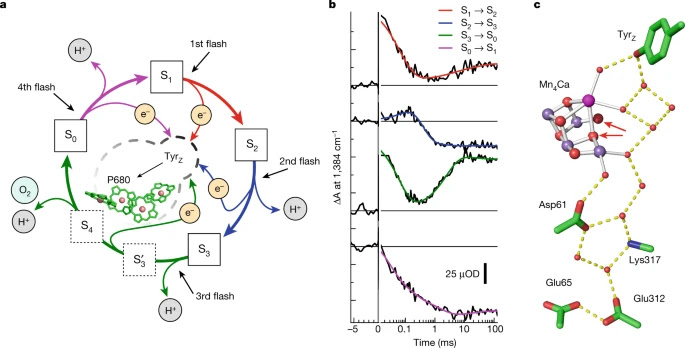
Photosynthesis fuels life on Earth by storing solar energy in chemical form. Today’s oxygen-rich atmosphere has resulted from the splitting of water at the protein-bound manganese cluster of photosystem II during photosynthesis. Formation of molecular oxygen starts from a state with four accumulated electron holes, the S4 state—which was postulated half a century ago1 and remains largely uncharacterized. Here we resolve this key stage of photosynthetic O2 formation and its crucial mechanistic role. We tracked 230,000 excitation cycles of dark-adapted photosystems with microsecond infrared spectroscopy. Combining these results with computational chemistry reveals that a crucial proton vacancy is initally created through gated sidechain deprotonation. Subsequently, a reactive oxygen radical is formed in a single-electron, multi-proton transfer event. This is the slowest step in photosynthetic O2 formation, with a moderate energetic barrier and marked entropic slowdown. We identify the S4 state as the oxygen-radical state; its formation is followed by fast O–O bonding and O2 release. In conjunction with previous breakthroughs in experimental and computational investigations, a compelling atomistic picture of photosynthetic O2 formation emerges. Our results provide insights into a biological process that is likely to have occurred unchanged for the past three billion years, which we expect to support the knowledge-based design of artificial water-splitting systems. Main In all plants, algae and cyanobacteria, sunlight drives the splitting of water molecules into energized electrons and protons, both of which are needed for the reduction of CO2 and eventually carbohydrate formation2. Molecular oxygen (O2) is formed during this process, which transformed the Earth’s atmosphere during the ‘great oxygenation event’3, which began about 2.4 billion years ago. Light-driven water oxidation occurs at the oxygen-evolving complex, a Mn4CaO5 cluster bound to the proteins of photosystem II2,4 (PSII). The relationship between electron and proton transfer in the bottleneck steps of O2 formation has remained incompletely understood. We address this key step here using time-resolved Fourier transform infrared (FTIR) experiments 


Reaction cycle of photosynthetic oxygen evolution. figure 1 a, Model of the S-state cycle with sequential electron and proton removal from the oxygen-evolving site10,11,50. Starting in the dark-stable S1 state, each laser flash initiates oxidation of the primary chlorophyll donor (P680+ formation) followed by electron transfer from a tyrosine sidechain (TyrZ oxidation) and—in three of the four S-state transitions—manganese oxidation, until four electron holes (oxidizing equivalents) are accumulated by the Mn4Ca-oxo cluster in its S4 state. b, Example of tracing S-state transitions using IR absorption changes after excitation with visible-wavelength laser flashes (at zero on the time axis). The absorption changes (ΔA) are provided in optical density (OD) units. The IR transients at 1,384 cm−1 reflect symmetric stretching vibrations of carboxylate protein sidechains that sense changes in the oxidation state of manganese in the microsecond and millisecond time domain (coloured lines are simulations with time constants provided in Supplementary Table 2). Note that the scale on the x axis is linear below t = 0 and logarithmic above t = 0. c, The Mn4Ca cluster (Mn, violet; Ca, pink) in the S3 state with six bridging oxygens, the redox-active tyrosine (TyrZ), and further selected protein sidechains as well as water molecules (red spheres), based on crystal structures25. Assignment to polypeptide chains, numbering of the atoms of Mn4Ca-oxo and water molecules and hydrogen-bond distances are indicated in Supplementary Fig. 1. The two oxygens atoms that form the O–O bond in the oxygen-evolving S3 → S0 transition are indicated by red arrows.

Time-resolved tracking of O2 transition

To perform time-resolved infrared spectroscopy on PSII, we developed an FTIR step-scan experiment with automated exchange of dark-adapted PSII particles (Methods), thereby expanding previous experiments at individual wavenumbers towards detection of complete fingerprint spectra. The sample exchange system was refilled about every 60 h using PSII membrane particles with about 1.5 g of chlorophyll prepared from 40 kg of fresh spinach leaves for day and night data collection over a period of 7 months. We initiated the transitions between semi-stable S states by 10 visible light (532 nm) nanosecond laser flashes applied to the dark-adapted photosystems   Using a specific deconvolution approach based on Kok’s standard model1 (Fig. 1a), we obtained time-dependent S-state difference spectra for each of the individual transitions between the four semi-stable reaction-cycle intermediates S1, S2, S3 and S0 (for selected time courses see Extended Data Fig. 2).

We focus on the oxygen-evolution transition, S3 → S4 → S0 + O2, predominantly induced by the third laser flash, for which time courses at selected wavenumbers are shown in F (time-resolved spectra are shown in Extended Data Fig. 3). Multiexponential simulations of the time courses provided 5 time constants describing acceptor- and donor-side PSII processes, including the expected time constants of 340 µs and 2.5 ms. The 2.5-ms time constant (O2) corresponds to the reciprocal rate constant of the rate-determining step in O–O bond formation and O2 release8,9. The 340 µs time constant (H+) corresponds to an obligatory step of proton removal from the oxygen-evolving complex of PSII, as shown recently by time-resolved detection of X-ray absorption, UV-visible spectroscopy, recombination fluorescence and photothermal signals  resulting in a specific Mn(IV)4 TyrZox metalloradical intermediate that was also trapped in low-temperature magnetic resonance experiments  ‘Obligatory’ here signifies that the O–O bond formation chemistry can proceed only after proton removal is complete, as verified by the delayed onset of signals that trace manganese oxidation states or, generally, the O2 formation chemistry , which is also visible in the top time course of Fig.  For systematic analysis of the 2D time–wavenumber data array obtained by the FTIR step-scan experiment, we exploited that the requirement for wavenumber independence of the time constants of proton removal (H+ = 340 µs) and the electron transfer associated with O2 formation (O2 = 2.5 ms), because they always reflect the same reaction (the same rate constant). The time constants can thus serve as a kinetic tag of the reaction in the time-resolved spectroscopic data. By simultaneous simulation of the time courses at 2,582 wavenumbers (1,800 cm−1 to 1,200 cm1) using the same set of time constants at each wavenumber, we obtained the amplitude spectra shown in Fig.  , which are denoted as decay-associated spectra (DAS).


a, IR time traces at selected wavenumbers, demonstrating the delayed onset of O–O bond formation (1,381 cm−1) and reversible changes assignable to transient sidechain deprotonation (1,571 cm−1 and 1,707 cm−1). The corresponding wavenumbers in the spectra in bd are marked with coloured asterisks. bd, DAS corresponding to the proton release phase (H+ = 340 µs, blue line) and the oxygen-evolution phase (O2 = 2.5 ms, green) as well as the steady-state difference spectrum of the S3 → S0 + O2 transition (dashed black line). Red areas b,d mark inverted 340 µs DAS and 2.5 ms DAS, indicating reversible behaviour; purple shaded areas in c highlight the similarity of the 2.5 ms DAS and the steady-state spectrum, in line with the assignment to non-transient changes in Mn oxidation state. 

Visit: 

International Conference on Organic Chemistry https://organic-chemistry-conferences.sciencefather.com/

#environmentalchemistry #organicfarming #awards #chemistry #conference #inorganicchemistry #absorbent #biological #column Chromatography 

Social Media Link : 

Instagram: https://www.instagram.com/na.vy7928/ 

Twitter: https://twitter.com/AdinaAd27556369 

Blogger: https://chemistry5225.blogspot.com/

Linkedin: https://www.linkedin.com/in/adina-adina-130a0b263/

Friday, 12 May 2023

Understanding Isotope Exchange at Chemical Equilibrium for Better Carbon Dating

 In an article recently published in the journal Geochimica et Cosmochimica Acta, researchers discussed the calcite and fluid exchange rates for carbon and oxygen isotopes during chemical equilibrium.

Background

A window into Earth's past is created through the analysis of the isotopic composition of carbonate minerals, which keep a record of historical geochemical and climatic circumstances. Calcium carbonate minerals are excellent archives of the planet's previous climatic conditions. Effective use of any of these proxies requires knowledge of the mechanisms of isotope fractionation as well as preservation of isotopic and trace element compositions across timescales up to millions of years.

Despite the fact that numerous studies have documented the isotopic alteration of calcium carbonate and a number of other minerals while they were in chemical equilibrium and without morphological alteration visible at the level of electron microscope analysis, the mechanism underlying this alteration of isotopic composition is still not fully understood.

The theory of simultaneous forward and backward reactions has been applied in recent experimental studies to estimate the near-equilibrium reaction rates of a variety of minerals, including calcite, to account for the equilibration of isotopic compositions between fluid and solid after initial precipitation, and to explain isotope exchange at or near chemical equilibrium.

It is unclear what motivates dynamic equilibrium as an isotope exchange process; however, it may be related to isotopic disequilibrium. It is important to figure out the method by which the isotopic composition of calcite changes. For weakly crystalline materials, Ostwald ripening is probably a significant isotopic exchange control in the early stages of mineral precipitation and development. However, well-crystallized and old materials probably have less of a need for this mechanism.

About the Study


In this study, the authors carried out batch reactor experiments in chemical equilibrium between calcite and a fluid enriched in 13C and 18O relative to the solid at 25°C to assess the rates and processes by which C and O isotopes were exchanged between calcite and fluid. To assess the effect of mineral surface area and size on C and O isotope exchange rates, different grain sizes of natural and synthesized calcite were examined.

The team indicated the change of the O and C isotope compositions of calcite at ambient temperatures, which occurred easily over short time scales, while it was unclear how to determine the amount to which this process continued over geologic time scales.

The researchers assessed the rates of change in the C and O isotope composition of calcite at 25 °C and chemical equilibrium, as well as to produce new insights into a potential process. The ion activity product of Ca and CO32- and the solubility product of pure calcite were equivalent in this definition of chemical equilibrium. At chemical calcite-fluid equilibrium, a fluid enriched in 18O and 13C relative to calcite was exposed to both natural and synthetic calcite of various grain sizes in a series of batch reactor studies.

Observations

The specific process of isotope exchange was unclear between 72 hours and 2112 hours during the large calcite experiments and between 72 hours and the conclusion of the tiny and synthetic calcite studies at 3000 hours. The projected dissolving rate of calcite at a pH of 8 was four orders of magnitude lower than the C and O isotope exchange rate. In the synthetic, small, and first and second big calcite tests, the values of the 13C diffusion coefficients for the long-term exchange were 1.3 x 10⁻²⁴, 1.1 x 10⁻²³, 4.2 x 10⁻²⁶, and 1.2 x 10⁻²⁵ m2/s, respectively. In the synthetic, small, and second and first big calcite studies, the equivalent values for 18O diffusion coefficients were 1.3 x 10⁻²⁴, 1.0 x 10⁻²³, 2.0 x 10⁻²⁶, and 1.1 x 10⁻²⁵ m2/s, respectively.

According to the experimental findings, both C and O isotope exchange occurred quickly within 72 hours for all of the calcite grain sizes examined. The C and O isotope exchange rates slowed down after 72 hours but remained very stable over thousands of hours. For all calcite grain sizes examined, surface-area normalized O and C isotope exchange rates were comparable, and C and O were exchanged in a ratio of about 3:1, consistent with the exchange of CO32-.

The rates of O and C exchange were approximately four orders of magnitude lower than the rates of far-from-equilibrium calcite dissolution, which indicated that exchange was either governed solely by the dissolution-precipitation of the pre-existing reactive sites or by a combination of solid-state/aqueous mediated diffusion and dissolution-precipitation.

The findings of this study could serve as a further reminder of the significance of developing a mechanistic understanding of the isotope exchange mechanism in chemical equilibrium and as a first step in that direction.

Conclusions

In conclusion, this study indicated that the alteration of calcite's O and C isotope compositions at Earth's surface temperatures could occur easily over short time periods, while it was currently difficult to determine how far this process would continue over geologic time scales. When there was isotopic disequilibrium, there was a rapid initial exchange between fluid and solid that was mostly due to species exchange on the surface.

Uncertainty persists regarding the mechanism underlying the observed slower rate of change in the C and O isotope composition of calcite across the longer time scales in the performed tests. Longer time periods of greater than 72 hours could see a combination of solid-state/aqueous mediated diffusion and dissolution-reprecipitation led to the change of carbon and oxygen isotopes.

However, the significant utility of carbonate isotopic and trace element compositions underscores the need for a mechanistic understanding of the solid-fluid exchange to enable reliable interpretation of sample selection and archives.

The authors mentioned that this is the first study to examine O and C exchange simultaneously and at bulk calcite-fluid equilibrium with high purity calcite, opening up fresh perspectives on the processes and rates of isotope exchange.

International Conference on Organic Chemistry https://organic-chemistry-conferences.sciencefather.com/ #environmentalchemistry #organicfarming #awards #chemistry #conference #inorganicchemistry #absorbent #biological #column Chromatography Social Media Link : https://www.instagram.com/na.vy7928/ https://twitter.com/AdinaAd27556369 https://chemistry5225.blogspot.com/ https://www.linkedin.com/in/adina-adina-130a0b263/


Monday, 1 May 2023

The Role of Ion Mobility Spectrometry - Mass Spectrometry (IMS-MS) in the Pharmaceutical Industry

Ion mobility spectrometry coupled with mass spectrometry (IMS-MS) is a powerful hyphenated technology widely used for pharmaceutical applications that benefit from increased measurement sensitivity, peak capacity, and scope of molecular data.


As a stand-alone technique, IMS is used for rapid molecular separations in the gas phase based on the size, shape, charge, and mass of ions. Coupling with MS (IMS-MS) adds an extra dimension of resolution by enabling the separation and structural characterization of similar species for accurate identification and quantification of analytes.

Interest in IMS-MS has grown considerably over the last two decades and the number of systems available on the commercial market is expanding as ion mobility increasingly becomes an integral part of high-end mass spectrometers.

The more advanced, popular and available IMS-MS systems become, the more these instruments are being routinely applied in numerous different areas for the study of large molecules and complexes, as well as small molecule research.

The important transformations that the diversifying IMS-MS technique is making to the field of biomedical research will be a hot topic at Pittcon 2020 in Chicago IL and will be the central focus of the 31st James L Waters Symposium.

Combining IMS with TOF-MS systems

Since IMS separation occurs on the millisecond timescale, combining it with time-of-flight (TOF) MS systems is particularly popular because the unprecedented data acquisition rate of TOF-MS allows thousands of MS spectra to be generated in this millisecond separation timeframe.

In a session entitled “Ion Mobility Spectrometry-Mass Spectrometry (IMS-MS),” Kevin Giles will present his talk “The Development of Travelling Wave Ion Mobility Separation.” Giles will discuss the more recent uptake of IM-MS in the context of the increasing availability of high-performance instruments. Giles will describe the development of the technology behind the Synapt HDMS (quadrupole/IM/time-of-flight [TOF]MS) launched by Waters in 2006 and the traveling wave (TW)-based mobility separator that it features.

The use of IMS-MS in the pharmaceutical industry for protein characterization

In the pharmaceutical industry, accurate characterization of protein structure is crucial to understanding protein function and in facilitating the design of effective therapeutics. IMS separates ions based on their differential mobility through a drift-tube containing buffer gas. The differing mobility depends on an ion’s characteristic collision cross-section (CSS), which is greater in the case of larger ions that experience more collisions and take longer to cross the drift tube than smaller ions. One problem with IMS is that CCS data can only be averaged because gaseous ions collide with the buffer gas in various different orientations. However, interfacing with MS overcomes this problem and enables accurate characterization of proteins structures and complexes (Ashcroft et al 2013).

Coupling with liquid chromatography

The fast measurements IMS–MS provides means it couples well with other front-end analytical separations, such as liquid chromatography and capillary electrophoresis (Robinson and Jiang 2013).

Capillary LC-MS is now broadly applied in various areas of analytical application, particularly when high dynamic range characterization of complex mixtures is desired. The high-speed of IMS, as well as its robust nature, easy coupling with MS and the provision of additional structural information has meant IMS separations have gained increasing interest. However, one limitation is the resolving power that can be achieved.

This year at Pittcon Richard Smith will give a talk on “Ion Mobility Separations with Mass Spectrometry based upon Structures for Lossless Ion Manipulations (SLIM),” Smith will outline new approaches using traveling wave (TW) based Structures for Lossless Ion Manipulations (SLIM) and their application in conjunction with MS. He will describe the broad flexibility for manipulating ions in SLIM, and the multi-pass separations this provides to achieve much higher IM resolution and problematic separations than were previously possible.

International Conference on Organic Chemistry https://organic-chemistry-conferences.sciencefather.com/ #environmentalchemistry #organicfarming #awards #chemistry #conference #inorganicchemistry #absorbent #biological #column Chromatography Social Media Link : Instagram: https://www.instagram.com/na.vy7928/ Twitter: https://twitter.com/AdinaAd27556369 Blogger: https://chemistry5225.blogspot.com/ Linkedin: https://www.linkedin.com/in/adina-adina-130a0b263/

Friday, 21 April 2023

Regulatory requirements for chemicals in the pharmaceuticals industry

Ensuring compliance in research and manufacturing is fundamental across all industries, especially where controlled and regulated chemicals are concerned.

Any industry that uses large amounts of chemicals must be able to identify and handle both controlled and regulated substances appropriately.

Today’s chemical and pharmaceutical industries are faced with an increasing number of regulatory requirements pertaining to the safe and legal storage, supply, and usage of chemicals.

For most, the legislations that first springs to mind typically relate to COSSH, MSDS, and possibly REACH when correctly using chemicals in bulk. However, for chemicals and regulatory managers, such legislation only corresponds to a small subset of the regulations which should be taken into account.

Detailed and complex regulations relating to controlled drugs, chemical weapons, and the precursor chemicals that can be used to make them are extremely important, ozone-depleting, military and dual-use chemicals, and the PIC/Rotterdam convention also may need to be taken into consideration. A large number of common chemicals and intermediates fall under the remit of these laws. It is often these regulations which are more applicable to R&D and manufactering in the pharmaceuticals industry.

The greatest obstacle to ensuring compliance is to first establish exactly what regulated or controlled chemicals you have. For more extensive chemical libraries, particularly those with proprietary or novel chemicals attempting to match keywords or names is much more complicated and often will not work.

Moreover, today’s legislation is no longer concerned with regulating a single substance. Instead, millions of chemicals may be covered by “generic statements” or "chemical family controls" to control areas of chemical space that possess similar properties.

Using keywords and name-searching approaches when dealing with generic statements is not feasible as the majority of chemicals they control are not named and may not even exist yet.

Scitegrity has published a white paper discussing some of these challenges and key, simple steps that can be followed to improve compliance, identify regulated chemicals and make compliance more robust. To find out more and read the white paper, please click here.

Want to know if your chemical is controlled, regulated, has the potential for abuse or just need a tariff code?

Our regulatory and chemistry experts encode chemical regulations from around the world allowing you to simply answer these questions and more by drawing or looking up a chemical structure.

We make regulatory compliance a simple, robust, background process. Join with 5 of the worlds top 10 pharma, chemical suppliers, regulators, CROs, forensics labs and more who trust and rely on our solutions.

Scitegrity was founded in 2011 by ex-Pfizer, GSK and Roche chemists and data scientists with the goal of making compliance to chemical regulations are far more robust, accurate and automatic.

By automatically checking all the chemicals an organisation has at the structure level, it allows enterprise wide automatic compliance checks against hundreds of regulations globally, even for novel and proprietary chemical collection running into millions of chemicals.

International Conference on Organic Chemistry https://organic-chemistry-conferences.sciencefather.com/ #environmentalchemistry #organicfarming #awards #chemistry #conference #inorganicchemistry #absorbent #biological #column Chromatography Social Media Link : https://www.instagram.com/na.vy7928/ https://twitter.com/AdinaAd27556369 https://chemistry5225.blogspot.com/ https://www.linkedin.com/in/adina-adina-130a0b263/ https://www.tumblr.com/adina-chemistry

Monday, 3 April 2023

Protecting Groups of Oligosaccharides

Oligosaccharides are constructed from carbohydrate monomer units which contain multiple hydroxyl groups, along with amino and carboxyl groups. Protecting groups play a vital role in oligosaccharide synthesis as they help in differentiating not only the same type of functional groups but also the different functional groups present in the carbohydrate.


Oligosaccharides are one of the most important class of biomolecules, playing a critical role in important biological processes like cell adhesion, immune response, bacterial and viral infection and cell differentiation and proliferation.

However, due to their low abundance in nature, it is difficult to get pure, structurally well-defined and reasonable quantities of oligosaccharides. The chemical synthesis of oligosaccharides has been instrumental in solving this problem for evaluating critical biological processes.

Desired characteristics of protecting groups

The synthesis of oligosaccharides is a challenge. This is due to the versatility of glycosylation (either alpha or beta linkages) and the presence of a large number of functional groups which necessitate the use of specific protecting groups to obtain the desired chemoselectivity and regioselectivity.

Protecting groups are used to temporarily mask a functional group that cannot survive the chemical environment. However, they can participate directly or indirectly in the glycosylation reactions altering the stereochemical outcome. Hence, an ideal protecting group should have the following characteristics:

  • Readily available
  • It should not introduce the formation of new stereogenic centers
  • Stable in order to withstand the synthesis process
  • Creates a product that is more lipophilic and crystalline
  • The by-products produced should not alter other parts of the molecule and be able to be easily removed

2-O-acyl group:

Classical neighboring group participation involves the participation of the acyl group at C2 position. In the glycosylation reaction, the acyl group of the donor aids in the removal of an activated leaving group leading to the formation of the stable dioxolenium ion. Therefore, the glycosyl acceptor can attack only from one side to form the 1,2-trans glycoside.

Many ester-type groups such as acetate, chloroacetate, benzoate and pivaloate have been used to make 1,2-trans glycosidic linkages. Occasionally, formation of orthoesters and harsh removal conditions prevent the formation of 1,2-trans glycosides.

Improved ester groups like 4-acetoxy-2,2-dimethylbutanoyl (ADMB) overcome these drawbacks and enable stereoselective synthesis of b-glucopyranosides.

The deprotection conditions are mild involving hydrogenolysis through intramolecular lactonization. 3-(2-Hydroxyphenyl)-3,3-dimethylpropanoate (DMBPP) and 3-(2-hydroxy-4,6-dimethylphenyl)-3,3-dimethylpropanoate groups (TMBPP), when placed at the C2 position enable synthesis of  b-glucopyranosides and a-mannopyranosides in good yield. These groups are removed by hydrogenolysis in the absence of acid or base.

Dialkyl phosphates:

The glycosylation of a thioglycoside having a 2,2-dimethyltrimethylene (DMTM) phosphate group at the C2 position leads to the formation of 1,2-trans glycoside. The DMTM group is removed by sodium hydroxide in an ethanol-water solvent mixture.

Chiral auxiliary group:

A chiral auxiliary group is a substituted ethyl moiety that contains a nucleophilic group positioned at C2 of the glycosyl donor. Upon formation of a oxocarbenium ion, the participation of the nucleophilic moiety controls the stereochemical outcome of glycosylation by forming cis- or trans- decalin system depending on the configuration of the chiral auxiliary.

If the chiral auxiliary has a S-configuration, it favors the formation of 1,2-cis glycoside via a trans-decalin intermediate. If the auxiliary at C2 position of the glycosyl donor has a R-configuration, it gives 1,2-trans glycoside via a cis-decalin intermediate.

Conformation-constraining protection groups

Conformation-constraining protecting groups restrict the flexibility of the sugar ring aiding a certain conformation of the intermediate thereby making the glycosyl intermediate easily accessible from one side.

Cyclic bifunctional groups such as benzylidine, carbonyl (carbonate, oxazolidinone) and cyclic silyl groups are some examples of conformation-constraining protecting groups. The benzylidine group is used to construct a b-mannosidic linkage by the formation of an a-triflate intermediate.

Similar to the 4,6-O-benzylidene-directed mannosylation, carbonates also use the same mechanism for the synthesis of b-glucosides. The oxazolidinone group is very useful in the synthesis of a-2-amino-2-deoxyglucopyranosides and a-sialosides.

4-nitrophenyl chloroformate is used to introduce an oxazolidinone group as a non-participating group at C2 and enables the simultaneous differentiation of the 2-amino and 3-hydroxyl group from other hydroxyl groups. 5-N,4-O-carbonyl-protected sialyl donor showed high reactivity and high a-selectivity in sialylation reactions.

The glycosylation reaction with a donor having the cyclic silyl group di-tert-butylsilylene (DTBS) gives predominantly a-selective products. 3,5-O-Di-tert-butylsilylene group was introduced in an arabinosyl donor to construct b-selective arabinofuranosides which are important constituents of microbial and plant polysaccharides. A donor with 3,4-O-bisacetal protecting group was used for b-selective glucosylation.

International Conference on Organic Chemistry

Visit: https://organic-chemistry-conferences.sciencefather.com/

Social Media Link :

Friday, 24 March 2023

Revealed: the US is averaging one chemical accident every two days

Guardian analysis of data in light of Ohio train derailment shows accidental releases are happening consistently

Mike DeWine, the Ohio governor, recently lamented the toll taken on the residents of East Palestine after the toxic train derailment there, saying “no other community should have to go through this”.

But such accidents are happening with striking regularity. A Guardian analysis of data collected by the Environmental Protection Agency (EPA) and by non-profit groups that track chemical accidents in the US shows that accidental releases – be they through train derailments, truck crashes, pipeline ruptures or industrial plant leaks and spills – are happening consistently across the country.

By one estimate these incidents are occurring, on average, every two days.

“These kinds of hidden disasters happen far too frequently,” Mathy Stanislaus, who served as assistant administrator of the EPA’s office of land and emergency management during the Obama administration, told the Guardian. Stanislaus led programs focused on the cleanup of contaminated hazardous waste sites, chemical plant safety, oil spill prevention and emergency response.

In the first seven weeks of 2023 alone, there were more than 30 incidents recorded by the Coalition to Prevent Chemical Disasters, roughly one every day and a half. Last year the coalition recorded 188, up from 177 in 2021. The group has tallied more than 470 incidents since it started counting in April 2020.

The incidents logged by the coalition range widely in severity but each involves the accidental release of chemicals deemed to pose potential threats to human and environmental health.

In September, for instance, nine people were hospitalized and 300 evacuated in California after a spill of caustic materials at a recycling facility. In October, officials ordered residents to shelter in place after an explosion and fire at a petrochemical plant in Louisiana.

Among multiple incidents in December, a large pipeline ruptured in rural northern Kansas, smothering the surrounding land and waterways in 588,000 gallons of diluted bitumen crude oil. Hundreds of workers are still trying to clean up the pipeline mess, at a cost pegged at around $488m.

The precise number of hazardous chemical incidents is hard to determine because the US has multiple agencies involved in response, but the EPA told the Guardian that over the past 10 years, the agency has “performed an average of 235 emergency response actions per year, including responses to discharges of hazardous chemicals or oil”. The agency said it employs roughly 250 people devoted to the EPA’s emergency response and removal program.

Live in daily fear of an accident’

The coalition has counted 10 rail-related chemical contamination events over the last two and a half years, including the derailment in East Palestine, where dozens of cars on a Norfolk Southern train derailed on 3 February, contaminating the community of 4,700 people with toxic vinyl chloride.

The vast majority of incidents, however, occur at the thousands of facilities around the country where dangerous chemicals are used and stored.

“What happened in East Palestine, this is a regular occurrence for communities living adjacent to chemical plants,” said Stanislaus. “They live in daily fear of an accident.”

In all, roughly 200 million people are at regular risk, with many of them people of color, or otherwise disadvantaged communities, he said.

There are close to 12,000 facilities across the nation that have on site “extremely hazardous chemicals in amounts that could harm people, the environment, or property if accidentally released”, according to a Government Accountability Office (GAO) report issued last year. These facilities include petroleum refineries, chemical manufacturers, cold storage facilities, fertilizer plants and water and wastewater treatment plants, among others.

EPA data shows more than 1,650 accidents at these facilities in a 10-year span between 2004 and 2013, roughly 160 a year. More than 775 were reported from 2014 through 2020. Additionally, after analyzing accidents in a recent five-year period, the EPA said it found accident-response evacuations impacted more than 56,000 people and 47,000 people were ordered to “shelter-in-place.”

Accident rates are particularly high for petroleum and coal manufacturing and chemical manufacturing facilities, according to the EPA. The most accidents logged were in Texas, followed by Louisiana and California.


Visit:

International Conference on Organic Chemistry https://organic-chemistry-conferences.sciencefather.com/

Social Media Link :